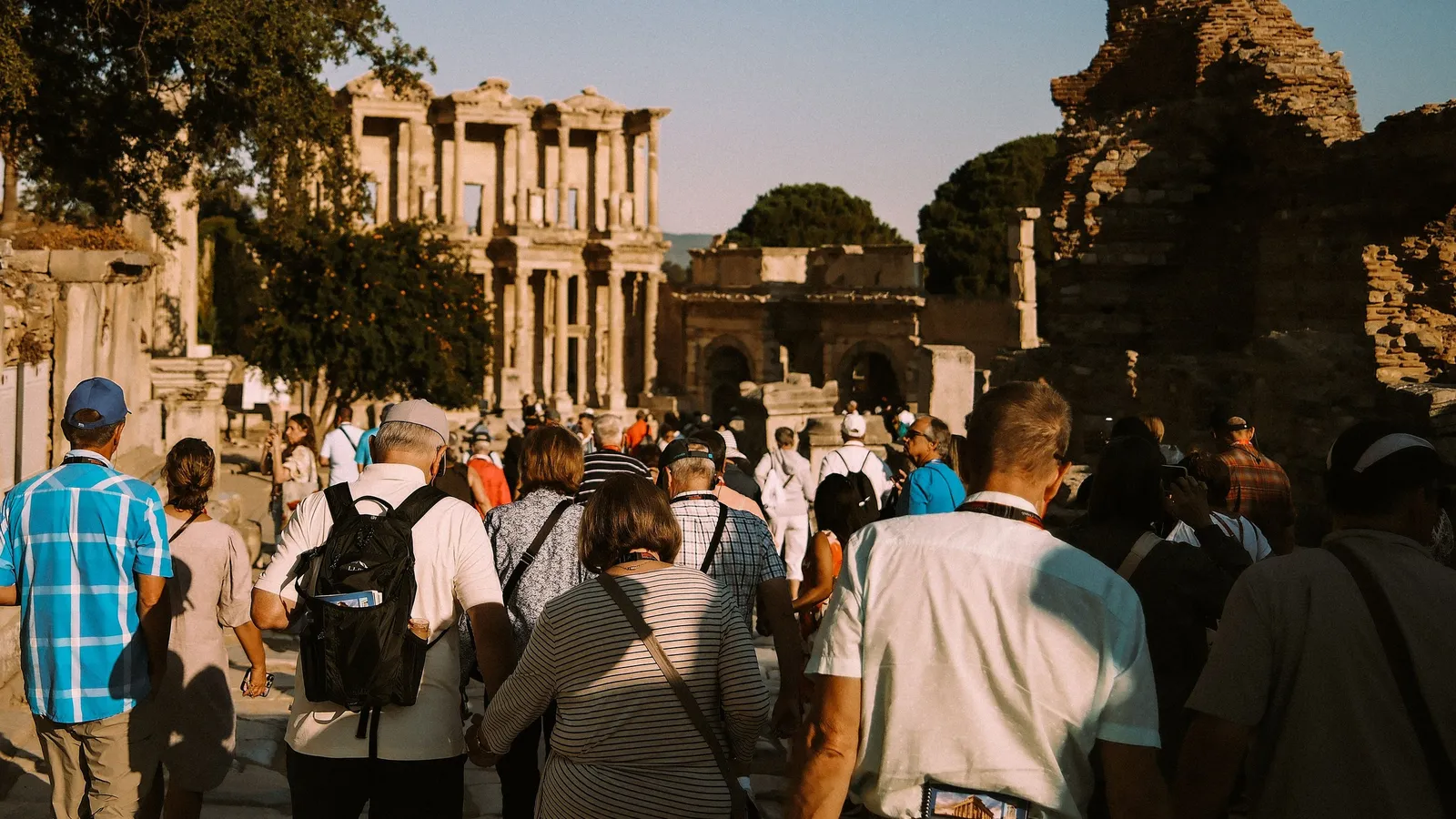
There is a fair amount of walking at Ephesus, but it is the gentle kind: one long street paved in marble that runs downhill between two gates, with the famous monuments standing along it. The questions we hear most are about knees, heat, steps and wheelchairs, so this page answers them in turn, then sets out an easy-pace plan and the ways to see Ephesus with less walking. We are a local tour agency and we sell a day that keeps the walking short, so near the end we say plainly who each option suits.
How much walking is there at Ephesus?
About 1.5 km. The classic walk runs from the Upper Gate down to the Lower Gate (we measured 1,319 m), almost all of it gently downhill, and takes about 2.5 hours with stops. Adding the Terrace Houses brings it to about 3 hours, with stairs inside.
The slope is gentler than the word “hill” suggests. NASA’s satellite elevation data put the Upper Gate at about 46 meters above sea level and the Library of Celsus at about 8 meters, so almost all of the descent is behind you by the time you reach the Library. Marble Street, the Great Theater and the path out to the Lower Gate are close to level.
What adds walking is choice rather than the route: the Terrace Houses halfway down, a climb into the seats of the Great Theater, and, for independent visitors, the walk back up to a car parked at the Upper Gate. One ticket is valid at both gates and taxis wait at the Lower Gate, so nobody needs to walk the route twice. Our map of Ephesus shows both gates, and how long to visit Ephesus breaks down the time.
| Stretch | Underfoot | Effort and shade |
|---|---|---|
| Upper Gate and the State Agora | Packed earth, gravel and marble; wide and open | Gentle downhill, almost no shade |
| Curetes Street | Polished marble slabs, a few low steps | The main slope; the roofed Terrace Houses halfway down on the left |
| Library of Celsus square | Level marble; nine steps up to the facade | The natural rest stop, with some shade at the edges |
| Marble Street to the Great Theater | Large, worn, uneven slabs | Close to level |
| Great Theater to the Lower Gate | Paved path | Level, under pine trees: the coolest stretch |

Is Ephesus hard walking? The marble, not the distance
For most visitors the distance is easy and the surface is the work. The streets are paved with original marble slabs polished by twenty centuries of feet, and they are uneven: slabs tilt, edges stand proud, and there are gaps where stones are missing. Dust makes the polish slippery in summer, and rain does the same in winter. Shoes with real tread matter more than fitness; our page on what to wear during an Ephesus tour has the details.

And there are steps, so here is exactly where they are:
- Curetes Street has a few low steps on its upper stretch.
- The Library of Celsus stands on a platform with nine steps across its whole front. You can see the facade perfectly well from the square without climbing them.
- The Great Theater is steep stone tiers. Its lower and middle rows are usually open, and you can take in the whole theater from the street below.
- The Terrace Houses are seen from stairs and raised steel-and-glass walkways under a modern roof. They are not wheelchair accessible.

The climbs at the Library, the theater and the Terrace Houses are all optional. Leave them out and the main route is a long slope rather than a staircase.


Heat and shade along the way
In July and August afternoons regularly pass 35°C, and the marble throws the heat back up at you. The upper half of the walk, from the Upper Gate down Curetes Street, has almost no shade. Relief comes lower down: the roofed Terrace Houses, the edges of the Library of Celsus square, and the pine trees along the path from the Great Theater to the Lower Gate.
So time the walk rather than toughen up for it. The site opens at 08:00 every day, according to the Ministry’s portal muze.gov.tr, and the first hours after opening and the late afternoon are the coolest and quietest. Carry about a liter of water per person and put your hat on before you reach the gate. Toilets are at both gates and nowhere in between. Our page on weather in Ephesus has the month-by-month picture, and Ephesus tickets and opening hours has the closing times.

Is there a lot of walking at Ephesus for seniors and slower walkers?
Usually not. Ephesus suits older visitors and slower walkers well, because the route runs one way, downhill, at whatever pace you set, and bad knees, a cane or simply a slower stride all fit into it. A few things make the day easier:
- Start at the Upper Gate and be collected at the Lower Gate, so the whole walk runs downhill.
- Bring a walking pole or a steadying arm for Curetes Street if downhill is what troubles your knees. The slope is behind you by the Library of Celsus.
- Rest by the shade, not the clock. The Terrace Houses, the Library square and the pines near the Lower Gate are the natural pauses.
- Leave the climbs out without guilt. The theater and the Library facade both look their best from below.
If even the gentle slope is too much, there are shorter ways in, set out below.
Is Ephesus wheelchair accessible?
Partly. A wheelchair user enters and leaves by the Lower Gate and sees the lower city: the Great Theater from below, Marble Street and the square in front of the Library of Celsus. Go with a helper, because the original paving is uneven. The descent from the Upper Gate is not a wheelchair route, and the Terrace Houses, with their stairs and raised walkways, are not accessible.
Strollers are a similar story: a stroller manages the main street with effort and plenty of bumps, while a baby carrier manages it with none. Our Ephesus with kids plan covers families in detail, and our Ephesus planning questions page has the short version. If anyone in your party uses a wheelchair or walks with difficulty, tell us when you inquire and we will plan the route around them.

An easy-pace plan for the walk
This is the order our guides walk at a gentle pace, following the Ephesus city tour route stop by stop.
- At the Upper Gate: toilets and water first, hat on. In summer, arrive for the 08:00 opening.
- The upper city: walk the open stretch past the Odeon and Domitian Square slowly; nothing is gained by hurrying in the sun.
- Curetes Street: the main slope. Keep to the flattest slabs, take the low steps one at a time, and stop often; there is something to look at every few meters, from the Hercules Gate to the Temple of Hadrian.
- The Terrace Houses, halfway down on the left: decide here. They take 30 to 45 minutes on stairs and walkways and need a second ticket, and they are the shadiest stop on the route.
- The Library of Celsus square: the long rest. Water, a snack, a seat on the steps if you like.
- Marble Street to the Great Theater: close to level. Look up at the theater from the street, and climb a few rows only if you want the view.
- The pine path to the Lower Gate: the coolest few minutes of the walk. Your driver or a taxi meets you here, so the walk ends at the bottom.
At this pace the walk takes about 2.5 hours, or about 3 with the Terrace Houses.
Ways to see Ephesus with less walking
If 1.5 km of uneven marble is more than you want, there are three good alternatives.
- A short visit from the Lower Gate. Enter at the bottom, walk the nearly level lower city to the Library of Celsus and back, and leave the way you came. You still see the Great Theater, Marble Street and the Library.
- A private guide who sets the pace. Most guided visits, ours included, start at the Upper Gate, but a guide can start at the Lower Gate when walking is hard or time is short, and stop as often as you need. Our private Ephesus tour can be planned this way.
- Ephesus from above, then the museum. Our most complete day, Saints, Sultans & Flavors, looks down on the whole ancient city from the Virgin Mary statue beside the Upper Gate and stops at the Magnesian Gate, then meets the city piece by piece in the Ephesus Museum. It keeps the walking to about 2 km across the whole day, on level lanes and museum floors, and it does not walk the marble streets inside the site.
Who each suits: the full downhill walk suits visitors who can manage 1.5 km of uneven stone at their own pace, with rests. The Lower Gate visit suits wheelchair users and anyone who can manage only short, level stretches. The day from above suits people who would rather not walk the marble at all, and anyone facing a hot July afternoon. All three are good ways to see Ephesus; the right one is the one your feet agree with.
Sources & further reading
- Türkiye Ministry of Culture and Tourism — museum and site e-tickets — opening hours and current fees
- NASA Earthdata — Shuttle Radar Topography Mission (SRTM) — elevation data for the heights of the Upper Gate and the Library of Celsus
- Wikipedia — Library of Celsus — the nine steps across the facade
- UNESCO World Heritage listing — Ephesus