
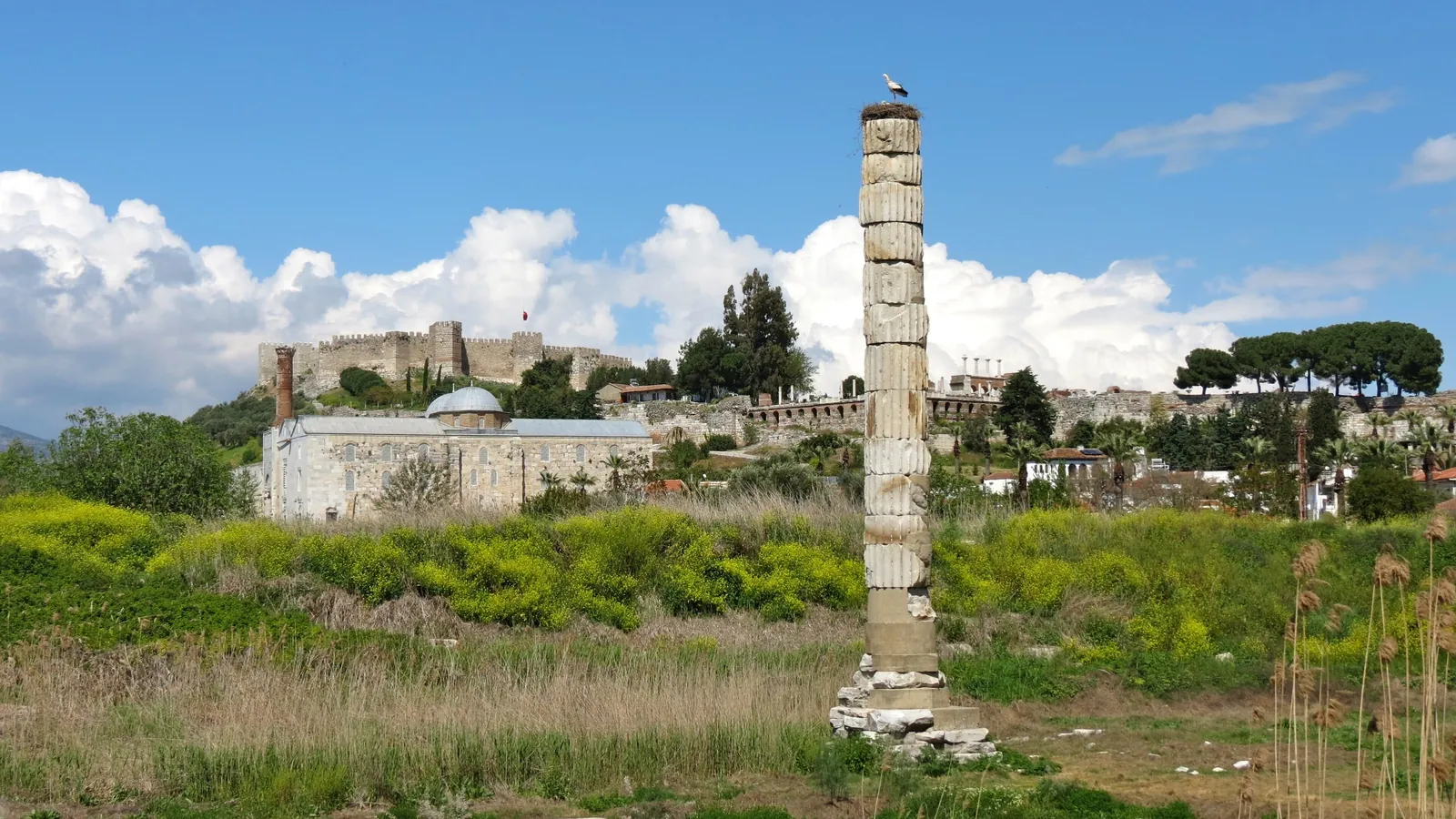
Temple of Artemis facts start with its size: Pliny the Elder gives the temple at Ephesus 127 columns, each 60 feet (about 18 meters) tall, on a floor of 425 by 225 feet, close to four times the ground area of the Parthenon. It was also a bank, a refuge for fugitives and the center of a goddess’s cult that drew pilgrims from across the Mediterranean. Below are 18 facts we tell beside the last column, each one checked against the ancient writers and the excavation reports. Where a popular story fails that check, we say so.
Why was the Temple of Artemis one of the Seven Wonders?
It was one of the largest temples the Greek world ever built, with 127 marble columns on a platform about twice the Parthenon’s length and width, and it was also a treasury, an asylum and a pilgrimage center. Antipater of Sidon, whose poem is one of the oldest surviving lists of wonders, ranked it first.
Antipater had seen the walls of Babylon, Zeus at Olympia, the Colossus of Rhodes and the pyramids, and wrote that when he saw “the house of Artemis that mounted to the clouds” the others lost their brilliance. Our page on the Seven Wonders of the Ancient World sets the Artemision beside the other six.
How it was built: facts 1 to 5
1. It stands on a marsh on purpose
Pliny writes that the builders chose marshy ground so the temple would not suffer from earthquakes. So that the vast building would not rest on a shifting bed, they laid trodden charcoal in the foundations and, on top of it, fleeces with the wool still on: an ancient shock absorber.
2. 127 columns, 36 of them carved
Pliny counts 127 columns, 60 feet high, “each of them presented by a different king.” That line is flattery, but the columns were real. Thirty-six had their lowest drums carved with life-size figures, and Pliny credits one of them to Scopas, among the most famous sculptors of the 4th century BC.

3. Nobody agrees exactly how big it was
Pliny’s 425 by 225 feet works out at roughly 130 by 69 meters, about twice the Parthenon’s length and width, which is where “four times the Parthenon” comes from. The excavators’ measured figures for the building are smaller, around 115 meters long, so a fair range is two and a half to four Parthenons. The high water table has never allowed a full excavation of the plan.
4. The columns rolled themselves to the site
The Roman architect Vitruvius tells how the first architects, Chersiphron of Knossos and his son Metagenes, moved column shafts from the quarry over soft ground. They set iron pins into each end, built a timber frame around the shaft and let oxen roll it along the road like a garden roller.
5. A goddess, the architect said, fixed the door
Chersiphron raised the heavy beams by piling sandbags up a ramp and slowly emptying them. The great lintel over the door would not settle level, and Pliny says he was so desperate he thought of killing himself, until Artemis told him in a dream that she had set the stone herself. In the morning it lay true. It is a legend, but an ancient one.
Kings, a fire and a refusal: facts 6 to 10
6. The richest king in the world signed his gift
Herodotus says Croesus of Lydia, the byword for wealth, paid for most of the columns of the archaic temple around 550 BC. Fragments of column bases found by the excavators carry a dedication that most scholars read as “King Croesus dedicated this,” and they are in the British Museum today.
7. Ephesus once tied itself to the temple with a rope
When Croesus besieged the city, Herodotus writes, the Ephesians dedicated their town to Artemis by stretching a rope from the temple to the city wall, seven stades away, more than a kilometer. The same king then paid for the temple’s columns.
8. An arsonist burned it for fame in 356 BC
A man named Herostratus set fire to the wooden roof beams and confessed that he wanted his name remembered. Ephesus executed him and banned his name, and writers recorded it anyway, which is why “herostratic fame” still means fame at any price. Some modern scholars doubt his motive, since he gave it only under torture.
9. It burned the night Alexander the Great was born
Plutarch passes on the tradition that the fire and Alexander’s birth fell on the same day, and the joke of Hegesias of Magnesia: no wonder the temple burned, since Artemis was away in Macedonia delivering the baby. Treat the date as a good story rather than a record.
10. Ephesus turned down Alexander’s money
In 334 BC Alexander offered to pay the whole cost of the rebuilding if his name went on the dedication. Strabo records the reply: it was not fitting for a god to dedicate offerings to gods. The Ephesians paid for it themselves, with the women’s jewelry, their own property and the sale of the old temple’s columns.
Bank, refuge and priests: facts 11 to 14
11. It was the safest bank in Asia
Kings, cities and private citizens deposited money in the Artemision, because robbing it was sacrilege, not mere theft. The Athenian soldier and writer Xenophon left his share of war spoils with the temple warden before a dangerous campaign, with orders to spend it on the goddess if he did not return. He survived, and the warden later handed the money back to him.
12. Its refuge was measured with an arrow
A fugitive inside the sacred boundary could not be seized. Strabo says Alexander extended the boundary to one stadium, Mithridates shot an arrow from the corner of the roof and claimed as far as it flew, and Mark Antony doubled the distance, taking in part of the city. Criminals moved in, and Augustus canceled the extension.
13. Eunuch priests, and priestesses called bees
Strabo writes that the chief priests were eunuchs called Megabyzi, a Persian name, served by unmarried girls. The priestesses were known as melissai, “bees,” and the bee is the emblem on Ephesian coins for centuries. The Artemis of Ephesus worshipped here was an Anatolian mother goddess in Greek dress, not the slim huntress of Greek myth.

14. Some of the oldest coins in the world were found in it
Digging for the British Museum in 1904–05, D. G. Hogarth found electrum coins of the 7th century BC in the earliest levels of the sanctuary, among the first coins struck anywhere. Money here was born in a temple deposit, not a market stall.
Riot, ruin and rediscovery: facts 15 to 18
15. The Bible calls it the temple of Diana
Diana is simply the Latin name for Artemis, so the temple of Diana at Ephesus and the Temple of Artemis are the same building. In Acts 19 the silversmith Demetrius, who made silver shrines of the goddess, warns that Paul’s preaching will empty “the temple of the great goddess Diana,” and the crowd shouts “Great is Diana of the Ephesians” for about two hours in the Great Theater, which still stands.

16. The Goths burned it in the 260s AD
The historian Jordanes says Gothic raiders set fire to the temple of Diana at Ephesus. The date is argued between 262 and 267–268, and how much they destroyed is unknown. Worship went on at the site in some form until around 401, but the temple was never rebuilt on the old scale; our post on what happened to Ephesus follows the rest of the city’s decline.
17. Its marble went uphill, not to Istanbul
Stone from the ruined temple was burned for lime or built into later buildings on Ayasuluk Hill above it, including the Basilica of St John and the İsa Bey Mosque. The popular story that columns of Hagia Sophia came from Ephesus is a late medieval legend with no ancient support.

18. It was found on New Year’s Eve, under 20 feet of mud
The English architect John Turtle Wood searched for six years before striking the temple’s pavement on 31 December 1869, about 20 feet (6 meters) under river silt. The single column on the site today was re-erected in modern times from drums found there, and in spring storks often nest on top of it. How much of Ephesus has been excavated tells the rest of the digging story.

Five Temple of Artemis facts for kids
- It was so big that three or four copies of the Parthenon in Athens could fit on its floor.
- Its builders put charcoal and woolly sheepskins under it to protect it from earthquakes.
- The goddess’s priestesses were called “bees,” and Ephesus put a bee on its coins.
- A man burned it down just to become famous, and we still know his name: Herostratus.
- Only one column stands today, and storks often build their nest on top of it in spring.
Seeing the Temple of Artemis today
The site is on the edge of Selçuk, a few minutes’ drive from the ancient city, and our guide to the Temple of Artemis covers the visit itself. The column means far more once you have seen the goddess, so pair it with the Ephesus Museum, where both great Artemis statues stand. For opening hours and fees on the Ephesus side, check our tickets and opening hours page, and for more of the city, try our interesting facts about Ephesus.
Only one column stands, but the story it anchors fills a day. Our Saints, Sultans & Flavours tour stops at the column, walks you room by room through the museum where the statues that survived now stand, looks up at the Basilica of St John from its terrace and goes inside the İsa Bey Mosque, both built partly from the temple’s stone, with every ticket in the price. To add the marble streets of the ancient city as well, our stop-by-stop city tour route shows what a half-day Ephesus tour covers, with your guide holding priority tickets before you reach the gate and the entrance fee paid separately, at the official price.
Sources & further reading
- Pliny the Elder, Natural History 36.21 (Perseus, Tufts University) — size, columns, foundations, the lintel story
- Strabo, Geography 14.1.22–23 (Perseus, Tufts University) — Herostratus, Alexander’s offer, the asylum, the priests
- Britannica — Temple of Artemis
- Bible Gateway — Acts 19:23–41
- UNESCO World Heritage listing — Ephesus


