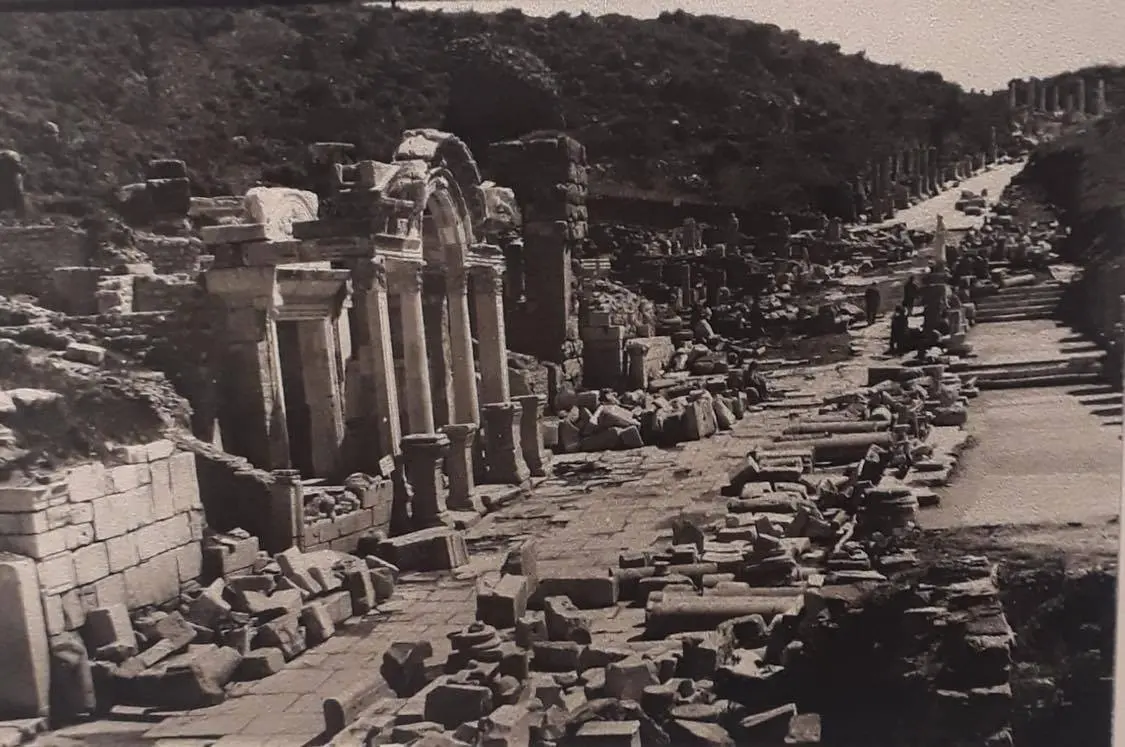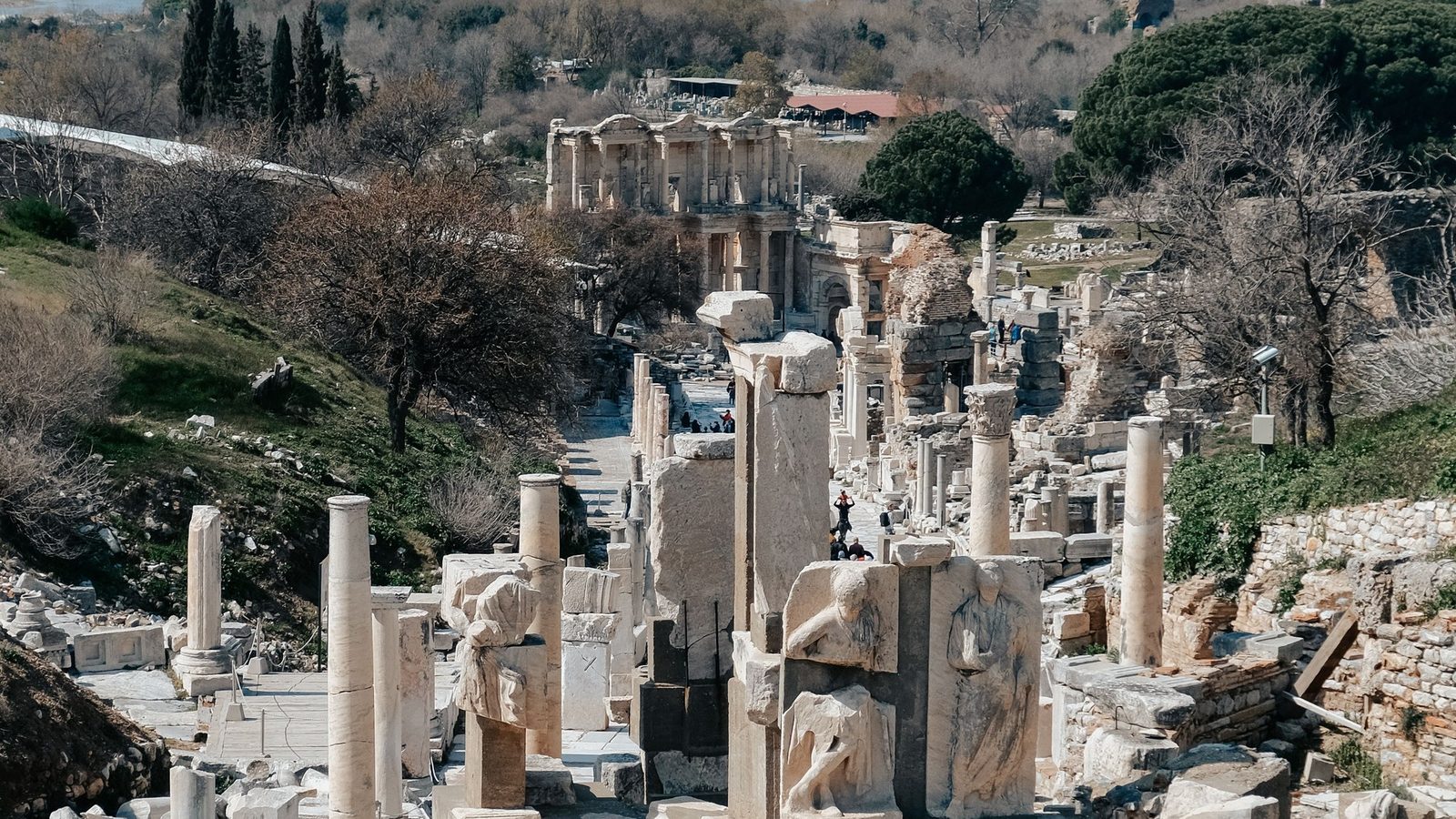
Most people walk Curetes Street, the great marble slope of Ephesus, in a few minutes with their eyes fixed on the Library of Celsus at the bottom. Slow down: there is something worth stopping for every few steps. Here are ten details, in the order you meet them walking down from the Upper Gate side, with what to look for at each one.
Add The Ephesus as a preferred source on Google
What is on Curetes Street in Ephesus?
Curetes Street in Ephesus holds, from top to bottom, the Memmius Monument, the Hercules Gate, the Fountain of Trajan, the Temple of Hadrian, the Scholastica Baths, the Terrace Houses, a mosaic sidewalk, the Octagon tomb and the public latrines, and it ends at the Library of Celsus.
The street links the civic quarter around the State Agora with the commercial quarter by the harbor, and it was part of the procession route of Artemis. Our map of Ephesus shows where it sits in the ancient city. The ten stops at a glance:
| # | What to notice | Where on the street |
|---|---|---|
| 1 | Memmius Monument | The top, at Domitian Square |
| 2 | Nike and the Hercules Gate | Top of the slope |
| 3 | Mismatched columns | All the way down |
| 4 | Fountain of Trajan | Upper half |
| 5 | Temple of Hadrian | Halfway down |
| 6 | Scholastica Baths | Behind the Temple of Hadrian |
| 7 | Terrace Houses roof | Opposite the Temple of Hadrian |
| 8 | Mosaic sidewalk | In front of the Terrace Houses |
| 9 | The Octagon | Lower end, Terrace Houses side |
| 10 | Public latrines | Bottom corner, by Marble Street |
Ten things to notice on Curetes Street, top to bottom
1. The Memmius Monument, built for a grandson of Sulla
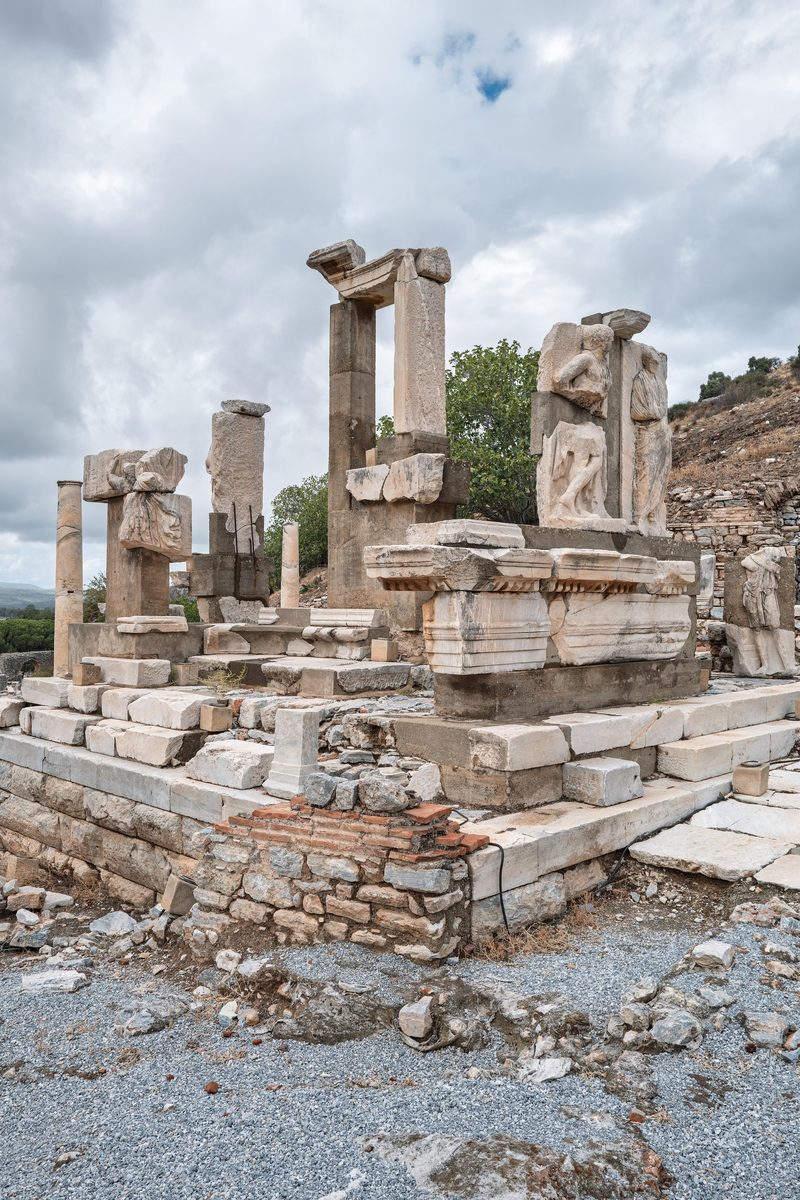
Where Domitian Square tips over into the street, look for a tall, broken monument with carved figures still standing in its niches. The Memmius Monument went up under Augustus for Gaius Memmius, and its inscription calls him the grandson of Sulla, the Roman general who took the province of Asia back from King Mithridates half a century earlier. A Roman victory monument at the head of a Greek city’s main street was not a subtle message.
2. Nike and the Hercules Gate
Just below, a relief of Nike, the winged goddess of victory, lies at knee height, holding out a wreath; it is generally thought to have crowned the gate a few steps farther on. The Hercules Gate itself is two marble pillars carved with Hercules wrapped in the skin of the Nemean lion. Look for the lion skin knotted across his chest. The carvings are older than the gate: in late antiquity the Ephesians reused them to narrow the street so that carts could not pass, and the slope below became a street for people on foot.

3. Columns that do not match, and the priests behind the name
Look along the colonnades: fluted shafts stand beside plain ones, on bases of different heights. After earthquakes in the 3rd and 4th centuries AD, fallen columns were replaced with whatever could be found, including drums from the Prytaneion, the town hall, carved with the name lists of the Curetes, a college of priests. Franz Miltner of the Austrian excavations cleared the street in the 1950s and named it after those inscriptions. The Ephesians probably called it the Embolos, “the wedge”, for the way it is wedged into the valley between Mount Pion and Mount Koressos. Glance down too: the slabs are worn smooth by footsteps, and the street’s Roman drain runs beneath them.
4. The Fountain of Trajan
In the upper half of the street, a long basin and a partly re-erected frame of columns mark the Fountain of Trajan, paid for by a wealthy citizen, Tiberius Claudius Aristion, and dedicated between AD 102 and 114. A colossal statue of the emperor once stood in the central niche with one foot on a globe: Rome, quite literally, on top of the world. The statue is gone. Step back across the street to see how high the facade once rose above the water.

5. The Temple of Hadrian, and what is really original
The small, elegant Temple of Hadrian is only about 10 meters wide, and a private donor, Publius Quintilius Valens Varius, paid for it, not the emperor. Look up at the front arch for Tyche, the goddess of fortune, then through it to Medusa in the half-moon over the inner door. The carved panels inside the porch, with the founding legend of Ephesus, are casts: the originals are indoors at the Ephesus Museum in Selçuk. The four empty pedestals in front are thought to have carried statues of the four Tetrarchy emperors of around AD 300.

6. Scholastica and her baths
Behind the temple rise the brick walls of the Scholastica Baths, built around AD 100 by the same Varius. In the entrance hall, a headless woman sits in a niche: Scholastica, a Christian benefactor who paid to restore the baths around AD 400, which is why the building carries her name rather than his.

7. The roof of the Terrace Houses
Across the street from the temple, the large modern roof on the slope shelters the Terrace Houses: seven homes of wealthy Ephesians stepped up the hillside, with wall paintings and mosaic floors still in place. They need a separate ticket, sold at the entrance beside the street (current prices are on our tickets and opening hours page), and take 30 to 45 minutes. The route inside runs on metal walkways and stairs, so the houses are not wheelchair accessible. On a hot afternoon this is the one shaded, sheltered part of the walk.
8. The mosaic sidewalk
In front of the Terrace Houses, look down. The covered walkway on this side of the street, known as the Stoa of Alytarches, is floored with about 285 square meters of mosaic in geometric panels, with flowers and birds among the patterns. It ran for some 53 meters past a row of shops, and an inscription addressed to a provincial governor shows the work was finished by AD 440. Most visitors cross it without a glance on their way to the Library. Walk along its edge instead and watch the patterns change from panel to panel.

9. The Octagon, a 2025 surprise
Near the lower end, on the same side, a square marble base about 9 meters wide is all that stands of the Octagon, an eight-sided tomb once about 13 meters high under a pyramid roof. For decades visitors were told it held Arsinoë IV, Cleopatra’s younger sister. In January 2025 a study in Scientific Reports settled it: the skull belonged to a boy of about 11 to 14. Who he was, and why he was given a tomb on the city’s grandest street, nobody knows.
10. The public latrines
At the bottom corner, where Curetes Street meets Marble Street, a doorway leads into the latrines of Ephesus: marble benches with keyhole-shaped seats along three sides of one room, no partitions, and a channel below where water from the baths next door ran all day. Romans sat here shoulder to shoulder and talked. Notice the shallow gutter at your feet in front of the seats; it carried clean water for rinsing.
Where Curetes Street ends
At the bottom, the street opens into the square in front of the Library of Celsus. Before you walk in, stop at the corner where Curetes Street meets Marble Street and look at the facade from there: it was designed to be seen from a little distance, and this is where the whole front fits in one view. From the same corner, Marble Street carries on north toward the Great Theater.
How long does it take to walk Curetes Street?
Only a few minutes at a steady pace, but allow 30 to 45 minutes to stop at the ten things above, plus another 30 to 45 minutes if you go into the Terrace Houses. The street is about 210 meters long and drops around 20 meters, with polished marble and a few low steps on its upper stretch, so wear shoes with good grip. There is little shade before the Terrace Houses; in summer, come at opening time or late in the day. Our guide to how much walking Ephesus takes covers the whole route.
Walking Curetes Street with a guide
Curetes Street is the middle of the classic route through the ancient city, from the Upper Gate down to the Library and on to the Great Theater; our Ephesus city tour page lists every stop in walking order. If you would like someone to point out these details as you go, our Ephesus half-day tour comes down Curetes Street at an unhurried pace, so each of the ten gets its minute. It is a private tour, from €33 per person for groups of 8 or more, with priority entry at the gate; entrance tickets are paid separately. Independent visitors who enjoy finding things for themselves can do the same walk with this list in hand.
Add The Ephesus as a preferred source on Google Google then highlights our articles for you in Top Stories and in its AI answers.
Sources & further reading
- Turkish Archaeological News — Curetes Street in Ephesus — length, width and slope, the Embolos name, the Curetes lists
- Turkish Archaeological News — Alytarches’ Stoa in Ephesus — the mosaic sidewalk in front of the Terrace Houses
- Scientific Reports (2025) — The cranium from the Octagon in Ephesos
- Austrian Archaeological Institute (OeAI) — The History of Ephesos
- UNESCO World Heritage listing — Ephesus