
Selçuk, Turkey is the town that took over when Ephesus emptied: its people moved up to Ayasuluk Hill, 3 km from the marble streets, and stayed. Everything worth seeing in Selçuk ties back to the ancient city, and all of it sits within a walk of the train station, so one unhurried day covers the town. Below are its sights in the order we would walk them, with how long each takes, where the tickets are needed and how many days to give the town.
Add The Ephesus as a preferred source on Google
What is there to see in Selçuk?
Seven sights, all walkable: the Basilica of St John and Ayasuluk Fortress on the hill, the İsa Bey Mosque and the old Turkish bath below it, the site of the Temple of Artemis, the Ephesus Museum, and the Byzantine aqueduct with its stork nests. Add the market on Saturdays. In the lanes between them stand a handful of small 14th-century mescits, of which the Kılıçarslan Mosque is the easiest to find.
The town and the ruins are two halves of one story. Our page on where ancient Ephesus is today explains how the city drifted from the harbor to this hill; this guide is about what you will find when you get here. UNESCO counts the hill and the temple site as part of the Ephesus World Heritage listing, so a day in Selçuk is a day inside the same site, just a later chapter of it.
Things to do in Selçuk, Turkey, in walking order
1. Ayasuluk Hill and the Basilica of St John
Start on the hill while the morning is cool. Justinian’s great church stands over the grave that Christians have honored as the tomb of John the Evangelist since the 2nd century, and the hill’s Turkish name, Ayasuluk, is a worn-down form of his Byzantine title, Hagios Theologos. You walk the nave between re-erected columns to the tomb slab, and look down over the plain from the terrace. Allow 45 minutes to an hour. Our Basilica of St John page tells the church’s full story.
2. Ayasuluk Fortress
The walls and towers on the summit are Byzantine, repaired by the emirs of Aydın and the Ottomans, and the fortress is open to visitors. Inside the circuit the remains are modest; the reward is the view, over Selçuk’s rooftops to the plain where the sea once reached and the hills that hide the ancient city. Add 30 minutes, and check the current ticket on the Ministry’s portal, muze.gov.tr.

3. The İsa Bey Mosque
At the foot of the hill stands the mosque that İsa Bey, emir of Aydın, raised in 1374–75. Its architect, Ali son of Mushimish, came from Damascus, and the plan with its open courtyard echoes the Great Mosque of that city. The builders reused older stone, and the dark granite columns of the courtyard and prayer hall come from earlier buildings, carried in from the ruins around the hill. It is a working mosque: visitors are welcome outside prayer times, with shoulders and knees covered, shoes off at the door and a scarf for women’s hair.

4. The old Turkish bath
Just beside the mosque, a cluster of brick domes pierced with small round skylights marks the bath of the emirs’ century, built to serve the mosque quarter and fed by clay pipes along the line of the aqueduct. It is a ruin seen from outside, a five-minute stop, but it is the link between the Roman baths of Ephesus and the hamam you can still book in town tonight. Our page on Turkish baths near Ephesus picks up that thread.

5. The Temple of Artemis
A short walk southwest of the mosque, one re-erected column stands in a marshy field: all that is upright of the Artemision, one of the Seven Wonders of the Ancient World. The site is open, entrance to the Temple of Artemis is included in our tours, and 20 minutes is enough. Stand by the column and turn around: the fortress, the basilica and the İsa Bey Mosque line the hill behind you, and some of their stone came from this field. Our Temple of Artemis guide covers the visit, and 18 facts about the temple tells its story.

6. The Ephesus Museum
Back in the town center, the Ephesus Museum holds what the excavators brought down from the ancient city: both great statues of Artemis Ephesia, the colossal head of an emperor once set up in the cult of the emperors, the bronze Eros on a dolphin, and a room on the gladiators of Ephesus. Give it an hour to 90 minutes, ideally in the hot middle of the day. It has its own ticket, separate from the ruins; our tickets and opening hours page explains which ticket covers what.

7. The aqueduct and its storks
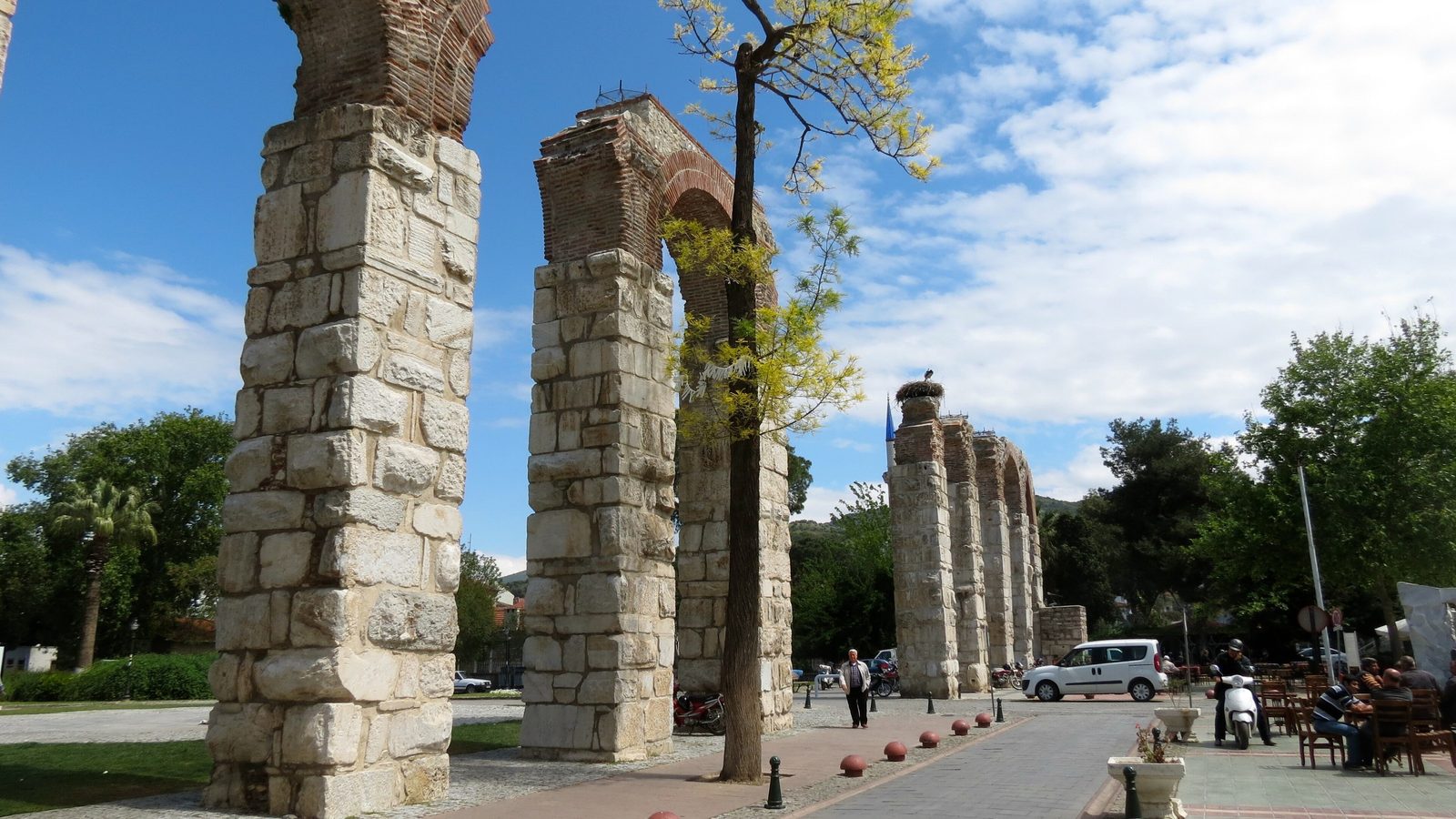
Walk back toward the station along the aqueduct, the arched line of stone piers that runs through the middle of town. It was built in the 6th century, about 650 meters of it, to carry water up to Ayasuluk Hill and the basilica. From early March, when the storks return, many of the piers carry a nest; in his excavation journal, John Turtle Wood noted the first stork of the season on 4 March and found every pier taken a few days later. They leave in late summer. This is also the monument people ask about when they see Selçuk from the road: the arches are the aqueduct, the lone pillar in the field is the Temple of Artemis.
Selçuk market days
The big weekly market in Selçuk is on Saturday, when farmers from the surrounding villages fill the streets beside the bus station with fruit, olives, cheese, herbs, olive oil soap and household goods from the morning on. It is a working market for local families, so go with a bag and some small lira notes rather than a list. On other days the shops around the aqueduct and the station square cover the everyday things. Our page on local traditions around Ephesus describes market day and the rest of the town’s week.
How many days in Selçuk?
One full day covers the town itself, in the order above. Two or three nights make sense if you use Selçuk as a base: one day for the ancient city (our how long to visit Ephesus page breaks down the hours), one for the town, and a half day for Şirince in the hills above or the House of the Virgin Mary. Evenings are quiet: dinner and tea in the squares under the aqueduct, while the storks settle on their nests.
| Stop | Time to allow | Ticket |
|---|---|---|
| Basilica of St John and Ayasuluk Fortress | 1 to 1.5 hours | Yes: €6 (€7 from 1 April 2027) |
| İsa Bey Mosque and the old bath | 30 minutes | Free; dress modestly |
| Temple of Artemis | 20 minutes | Included in our tours |
| Ephesus Museum | 1 to 1.5 hours | Yes: €10 (€11 from 1 April 2027), separate from the ruins |
| Aqueduct, old lanes, tea | As long as you like | Free |
Selçuk or Kuşadası as a base?
Selçuk suits travelers who want Ephesus at the gate: the ruins are 3 km away, a five-minute taxi, the regional train reaches İzmir Basmane in about 80 minutes, and the hotels are mostly small and family run. Kuşadası suits travelers who want the sea: a resort town on the coast, 19 km and about 25 minutes from Ephesus, with beaches, a long harbor front and many more restaurants. Both work well; it comes down to whether your evenings are for quiet squares or the waterfront. Our how to get to Ephesus page has the rest of the distances.
Seeing Selçuk with a guide
Selçuk is easy to walk alone, and with this page in hand you can. What a guide adds is the thread between the stops: why a mosque has Roman columns, which statue stood where in the ancient city. Our Saints, Sultans & Flavors tour is this page as a guided day: the Basilica of St John from its terrace, the inside of the İsa Bey Mosque, the old lanes and the bath, the Ephesus Museum room by room and the Artemis column, with lunch cooked by local women and every ticket in the price. To walk the marble streets of the ancient city as well, our Ephesus city tour route shows what a half-day Ephesus tour covers, with your guide holding priority tickets before you reach the gate and the entrance fee paid separately, at the official price.
Add The Ephesus as a preferred source on Google Google then highlights our articles for you in Top Stories and in its AI answers.
Sources & further reading
- UNESCO World Heritage listing — Ephesus (includes Ayasuluk Hill and the Artemision)
- Türkiye Ministry of Culture and Tourism — museum and site tickets — current fees and hours for the Basilica of St John and the Ephesus Museum
- Archnet — Isa Bey Camii, Selçuk — date, architect, reused columns
- Britannica — Ephesus


